organic history
“Metaurilia Orto di Mare” Ecomuseum
The project undertaken is a dialogic process between the geography of the place, the territory and its history.
Metaurilia was founded in the 1930s south of Fano, as a comprehensive land reclamation project. 115 farmhouses were built for market gardeners who also fished for a living. Time and haphazard urbanisation would obscure this development, leaving us today with the perception of an environment as a long alternating sequence of solids and voids along the state road, a building frontage of dubious architectural quality and, above all, lacking the qualities that make a place a space of identity.
It is from the need to reclaim one's own character, to enhance an existing heritage, that the dialogue between place and function, between architecture and its use, takes shape.
Between identity and the objective need for space, a process of transformation begins, like a metamorphosis that does not deny its origin, but that will take on a new appearance in order to recognise itself in it.
The First Act is the Reading of the Space, identifying the extraneous elements, the accretions that have settled over time, attaching themselves to the original body and altering its appearance.
The Second Act is equivalent to a surgical operation to remove these elements and the consequent temporary restoration of the original state: a cleaning operation, like a blank page on which to begin redrawing the future.
The Third Act is the Rewriting of the Space.
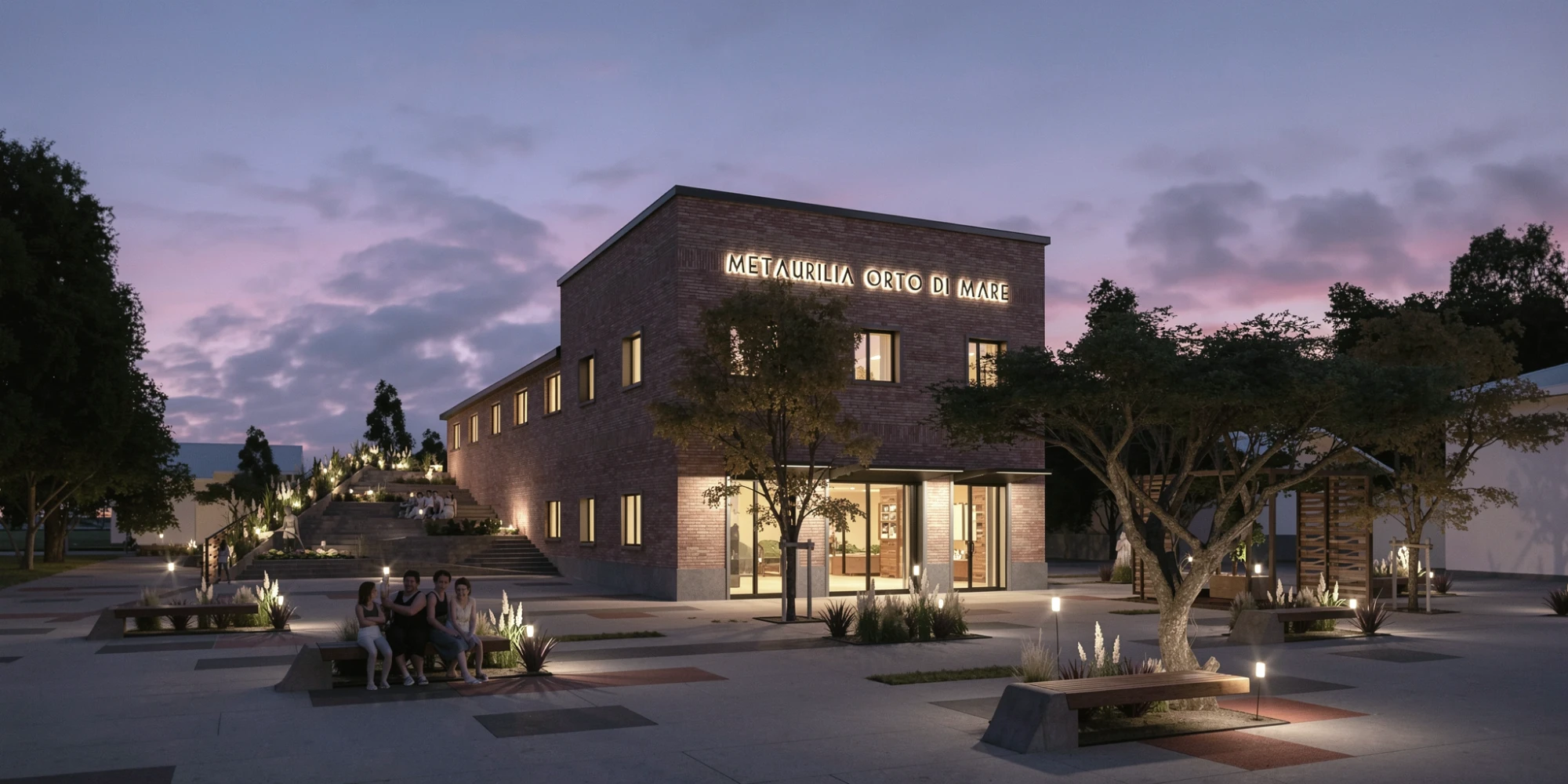
It is at this point that the project must find the right balance on the fundamental themes: the expansion of the building and the square as a public place.
Once again we intervene like surgeons, cutting into the ground and raising it to a first level, placing it in relation with the new levels of the museum.
A new organism thus originates, one that is simultaneously interior and exterior space, that partially embraces the old building and accompanies it onto the great square.
A structure that is not born with the pretension of standing out, but relates to and integrates with its context, expanding the public space and becoming a square itself.
The skin that wraps it draws inspiration once again from the history of the place. The fascination of the material, the images of crates containing vegetables, the ingrained toil: in short, a cladding that likens the architecture to a great virtual container that narrates the story of a Metaurilia both ancient and contemporary.
Also a physical container for small vegetable gardens and plantings that are slowly and carefully discovered along the path that climbs up the architecture itself. Step by step one encounters plant presences as natural pauses in a placid wandering. A stepped ascent that also becomes seating, but also an ascent via a ramp for those who move differently.
The Square, as a liquid element, permeates the spaces surrounding the museum and the church, becomes a trait d'union, takes on the role of binder and, above all, becomes a pleasant place to live.
It creates an organic context that relates the places and their respective functions, but is itself a protagonist in a harmonious, practical and evocative way.
The dialogue from which we began has led us here. Our architecture does not claim to find definitive solutions, but people, encounters, anecdotes and stories have brought us to this resolution so that Metaurilia and its Ecomuseum can coherently reclaim their own Identity.
Metaurilia was founded in the 1930s south of Fano, as a comprehensive land reclamation project. 115 farmhouses were built for market gardeners who also fished for a living. Time and haphazard urbanisation would obscure this development, leaving us today with the perception of an environment as a long alternating sequence of solids and voids along the state road, a building frontage of dubious architectural quality and, above all, lacking the qualities that make a place a space of identity.
It is from the need to reclaim one's own character, to enhance an existing heritage, that the dialogue between place and function, between architecture and its use, takes shape.
Between identity and the objective need for space, a process of transformation begins, like a metamorphosis that does not deny its origin, but that will take on a new appearance in order to recognise itself in it.
The First Act is the Reading of the Space, identifying the extraneous elements, the accretions that have settled over time, attaching themselves to the original body and altering its appearance.
The Second Act is equivalent to a surgical operation to remove these elements and the consequent temporary restoration of the original state: a cleaning operation, like a blank page on which to begin redrawing the future.
The Third Act is the Rewriting of the Space.
It is at this point that the project must find the right balance on the fundamental themes: the expansion of the building and the square as a public place.
Once again we intervene like surgeons, cutting into the ground and raising it to a first level, placing it in relation with the new levels of the museum.
A new organism thus originates, one that is simultaneously interior and exterior space, that partially embraces the old building and accompanies it onto the great square.
A structure that is not born with the pretension of standing out, but relates to and integrates with its context, expanding the public space and becoming a square itself.
The skin that wraps it draws inspiration once again from the history of the place. The fascination of the material, the images of crates containing vegetables, the ingrained toil: in short, a cladding that likens the architecture to a great virtual container that narrates the story of a Metaurilia both ancient and contemporary.
Also a physical container for small vegetable gardens and plantings that are slowly and carefully discovered along the path that climbs up the architecture itself. Step by step one encounters plant presences as natural pauses in a placid wandering. A stepped ascent that also becomes seating, but also an ascent via a ramp for those who move differently.
The Square, as a liquid element, permeates the spaces surrounding the museum and the church, becomes a trait d'union, takes on the role of binder and, above all, becomes a pleasant place to live.
It creates an organic context that relates the places and their respective functions, but is itself a protagonist in a harmonious, practical and evocative way.
The dialogue from which we began has led us here. Our architecture does not claim to find definitive solutions, but people, encounters, anecdotes and stories have brought us to this resolution so that Metaurilia and its Ecomuseum can coherently reclaim their own Identity.
date
2020
Client
Albatros ’87 Circolo Ricreativo Culturale
Location
Metaurilia, Fano
Coordination
Pia Miccoli, Maura Garofoli,Sauro Biagioni.
Founding sponsor
Regione Marche, Profilglass.
Albatros ’87 Circolo Ricreativo Culturale
Location
Metaurilia, Fano
Coordination
Pia Miccoli, Maura Garofoli,Sauro Biagioni.
Founding sponsor
Regione Marche, Profilglass.