where it all began
Musei Civici Pesaro
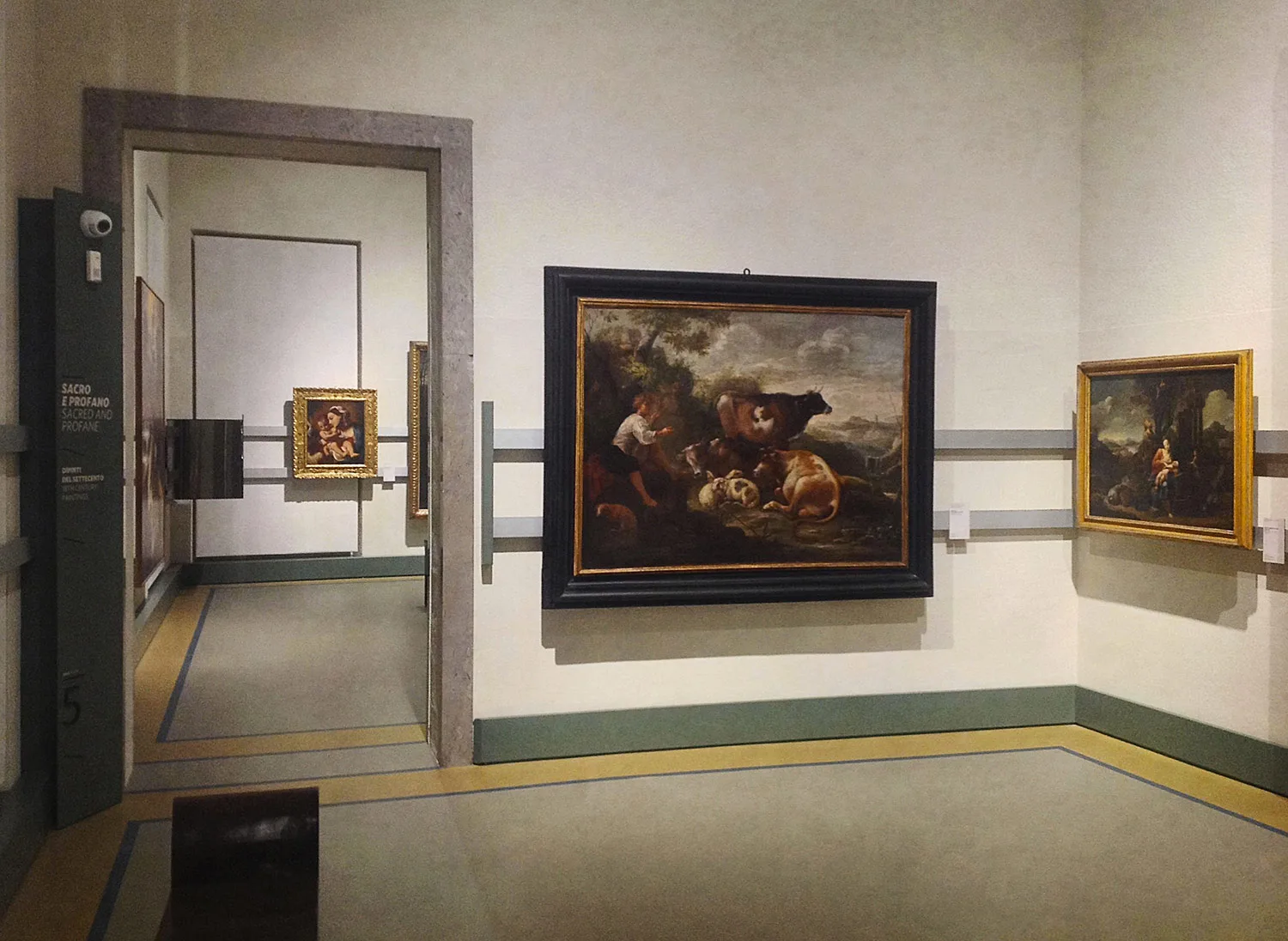
Completely renovated in 2013, the exhibition route takes into account both chronological and emotional criteria.
The museum collection is arranged in the five rooms of the first floor of Palazzo Mosca. The first room houses one of the masterpieces of the Italian Renaissance: the Coronation of the Virgin altarpiece by Giovanni Bellini. Painted by the Venetian artist around 1475, it was originally located in the Pesaro church of San Francesco. It immediately became an object of devotion among the faithful, despite the complex and not immediately obvious mystical-allegorical message underlying its iconography, evident above all in light of Franciscan belief. Stylistically, it is notable how the solemnity of the mystical event depicted in the central panel contrasts with the lively episodes from the lives of the saints in the predella.
Beyond its theological meaning, the altarpiece may also allude to a recognition of Sforza rule over the city, sanctioned in 1483 by the marriage of Camilla and Giovanni Sforza. In the room, in addition to the altarpiece, paintings from churches and convents in the city are displayed, representing significant moments in local figurative culture.
Ceramics and decorative arts, together with furnishings and sculptures, are displayed in the second room, a sort of “Wunderkammer” of the Pesaro museum. As for maiolica, a selection of the most representative narrative works from the main centres of the ancient Duchy of Urbino is on display — Urbino, Casteldurante (today Urbania), Pesaro, Gubbio — as well as sixteenth-century lustreware from Deruta. The room also holds masterpieces of decorative art from different periods, from the bequest of the Marchesa Vittoria Toschi Mosca.
The museum route then unfolds in chronological order: of great importance are the works of the Pesaro painter Simone Cantarini, in particular the pendant formed by the Penitent Magdalene and Penitent St. Joseph, and the striking Fall of the Giants by Guido Reni, probably conceived for the ceiling decoration of a private residence. The displayed heritage is completed by a group of still lifes whose subjects consist of wilted flowers, worm-eaten fruit, skulls and hourglasses; symbols linked to the theme of the fleetingness of beauty and the fragility of human existence. These range from the decorative and chromatic exuberance of Christian Berentz to the perspectival illusionism of Antonio Gianlisi Junior.
The Musei Civici are functional and welcoming also thanks to additional services such as the wi-fi corner, multimedia visit aids, the café and the conference room.
The museum collection is arranged in the five rooms of the first floor of Palazzo Mosca. The first room houses one of the masterpieces of the Italian Renaissance: the Coronation of the Virgin altarpiece by Giovanni Bellini. Painted by the Venetian artist around 1475, it was originally located in the Pesaro church of San Francesco. It immediately became an object of devotion among the faithful, despite the complex and not immediately obvious mystical-allegorical message underlying its iconography, evident above all in light of Franciscan belief. Stylistically, it is notable how the solemnity of the mystical event depicted in the central panel contrasts with the lively episodes from the lives of the saints in the predella.
Beyond its theological meaning, the altarpiece may also allude to a recognition of Sforza rule over the city, sanctioned in 1483 by the marriage of Camilla and Giovanni Sforza. In the room, in addition to the altarpiece, paintings from churches and convents in the city are displayed, representing significant moments in local figurative culture.
Ceramics and decorative arts, together with furnishings and sculptures, are displayed in the second room, a sort of “Wunderkammer” of the Pesaro museum. As for maiolica, a selection of the most representative narrative works from the main centres of the ancient Duchy of Urbino is on display — Urbino, Casteldurante (today Urbania), Pesaro, Gubbio — as well as sixteenth-century lustreware from Deruta. The room also holds masterpieces of decorative art from different periods, from the bequest of the Marchesa Vittoria Toschi Mosca.
The museum route then unfolds in chronological order: of great importance are the works of the Pesaro painter Simone Cantarini, in particular the pendant formed by the Penitent Magdalene and Penitent St. Joseph, and the striking Fall of the Giants by Guido Reni, probably conceived for the ceiling decoration of a private residence. The displayed heritage is completed by a group of still lifes whose subjects consist of wilted flowers, worm-eaten fruit, skulls and hourglasses; symbols linked to the theme of the fleetingness of beauty and the fragility of human existence. These range from the decorative and chromatic exuberance of Christian Berentz to the perspectival illusionism of Antonio Gianlisi Junior.
The Musei Civici are functional and welcoming also thanks to additional services such as the wi-fi corner, multimedia visit aids, the café and the conference room.
date
2013
Client
Comune di Pesaro, Coop Sistema Museo
Location
Pesaro
with
Migliore+Servetto, Sistema Museo, Arthemisia
Comune di Pesaro, Coop Sistema Museo
Location
Pesaro
with
Migliore+Servetto, Sistema Museo, Arthemisia