guardian of the past
Antiquarium di Colombarone
Immersed in the greenery of the San Bartolo Park, the archaeological area and the Antiquarium of Colombarone — a site rich in architectural traces, with an adjacent museum housing the finds from the excavations — document centuries of history of the mid-Adriatic territory.
Many years of research, from 1983 to 2008, made it possible to discover a unique and special area, from which a late antique villa, a basilica and a parish church emerged.
Dating from the late 3rd century AD, the manor house was the country residence of a landowner or a state official, and many of the mosaics, datable between the 4th and 6th centuries, are still visible today.
In the 6th century some sections of the structure were abandoned, while the representative area was transformed into a Christian church; it was in this period that what would become the early medieval basilica of San Cristoforo ad Aquilam, surrounded by a cemetery area, came into being.
In the following centuries (7th-10th), the church underwent numerous modifications, reaching considerable size, before becoming a simple parish church in the late Middle Ages. At the end of the 12th century the oldest part was demolished and the “Chiesola” was built in its place (itself demolished in 1858), of which a stretch of perimeter wall has been recovered.
Colombarone's function as a place of worship never faded. Not far away, a small church was built in the 19th century, and the current parish in the early decades of the 20th century.
The Antiquarium is housed in the spaces of the 19th-century church recovered by the Municipality of Pesaro.
A multimedia video introduces the visit with an immersive and evocative reconstruction of the villa's rooms, rich in coloured wall coverings and decorations.
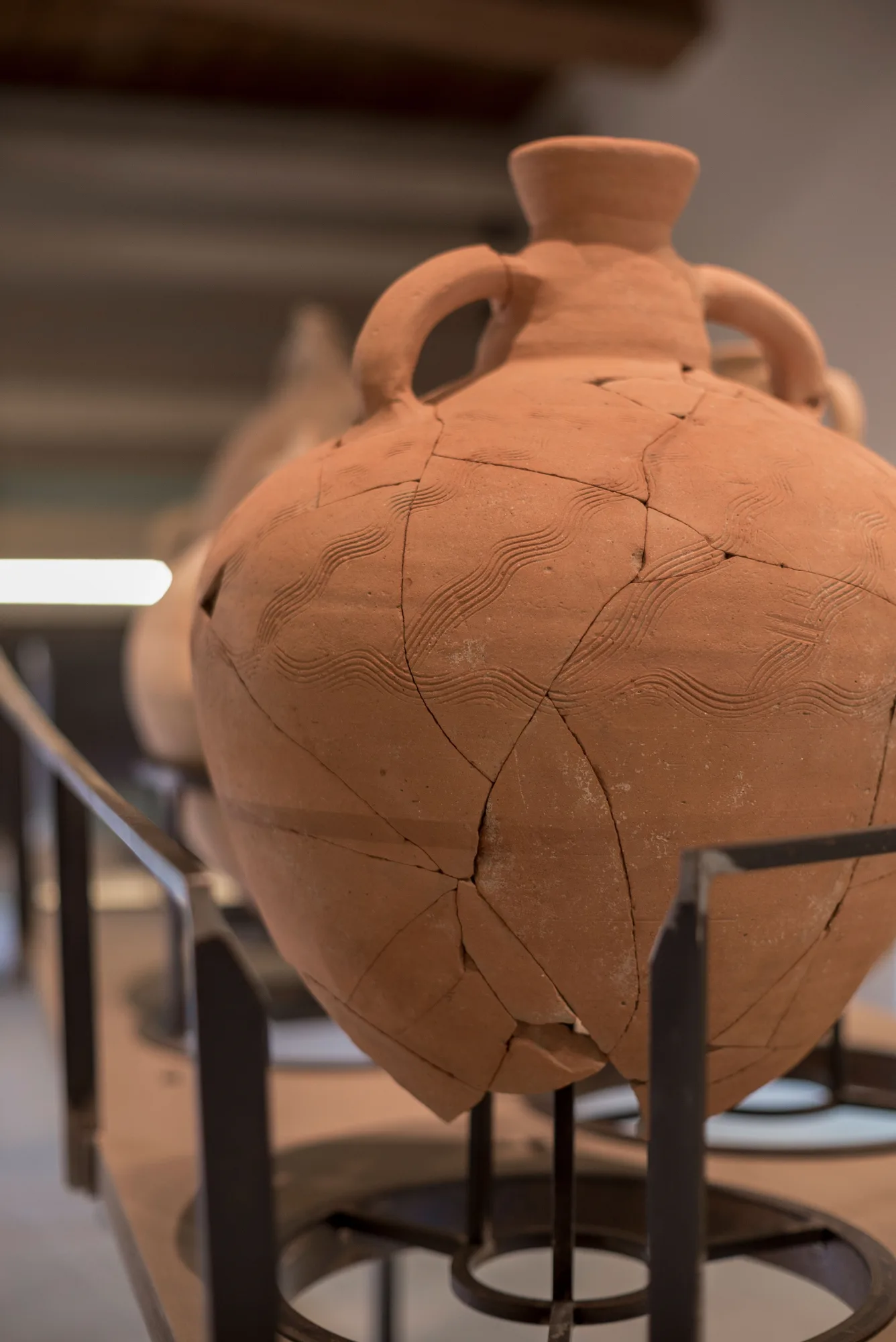
The small and precious museum tells the story of the excavations, starting with the identification of the site by Annibale Degli Abbati Olivieri, and displays the finds unearthed during the research. Among the materials connected to the manor house (3rd-6th centuries) are stretches of lead piping for water supply to the thermal area, ceramics, bronzes, glass, dining tableware, and amphorae attesting to food supplies from across the Mediterranean basin.
But it is the basilica (6th-8th centuries) that yields the most singular finds, including a stained-glass window, fragments of the church's marble iconostasis (the separation between the choir and the naves, formed by an architrave supported by columns), and a rare example of a multi-light hanging lamp (polycandilon), found together with a small hoard of coins and glass chalices from the liturgical equipment.
Finally, there is no shortage of interesting objects from the private life of the site's ancient inhabitants (ornaments and clothing items, coins, simple household tools).
date
2019
Client
COOP SISTEMA MUSEO
Location
Colombarone, Pesaro
Scientific project
Pierluigi Dall’Aglio_Università di Bologna, D.I.S.C.I.
Coordination
Coop Sistema Museo, Luca Montini.
Graphic
Emanuele Barduagni_EB85 – Visual Designer
Photo
Edoardo Montaccini
Construction managers
Paolo Cattano with Andrea Olmeda
Suppliers
Slam
COOP SISTEMA MUSEO
Location
Colombarone, Pesaro
Scientific project
Pierluigi Dall’Aglio_Università di Bologna, D.I.S.C.I.
Coordination
Coop Sistema Museo, Luca Montini.
Graphic
Emanuele Barduagni_EB85 – Visual Designer
Photo
Edoardo Montaccini
Construction managers
Paolo Cattano with Andrea Olmeda
Suppliers
Slam